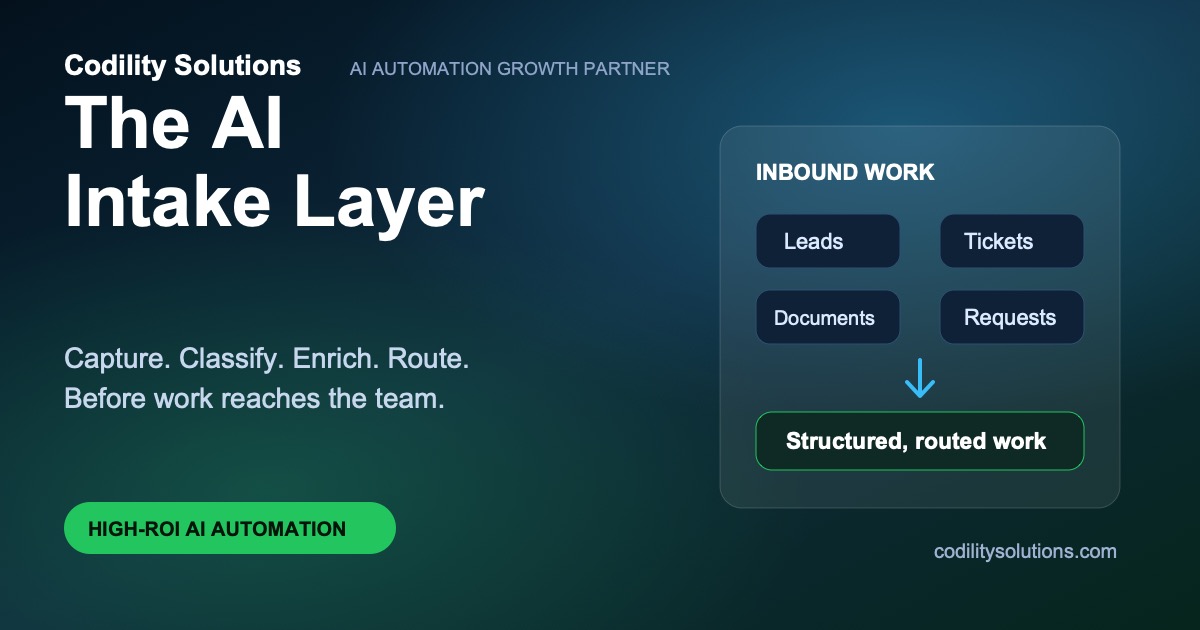
AI automation projects often start with the wrong question: "Which task should we automate?" That sounds practical, but it usually sends teams into disconnected experiments. One team builds a support bot. Another tries CRM enrichment. Operations tests document extraction. Sales asks for call summaries. None of it compounds.
A better first question is: "Where does work enter the business, and what happens before a human touches it?"
That entry point is the intake layer. It is where demand becomes work. It includes demo requests, inbound emails, support tickets, uploaded documents, voice calls, website forms, Slack requests, partner referrals, and customer onboarding packets. In most companies, intake is messy, slow, and manually triaged by people who should be doing higher-value work.
Why Intake Is Usually the Best First AI Automation
Intake is high-frequency, rules-heavy, measurable, and expensive when it is slow. That makes it ideal for AI. You do not need a fully autonomous agent making complex business decisions. You need a reliable system that reads the request, understands what it is, fills in missing context, sends it to the right place, and triggers the next action.
Sales
Qualify inbound leads, enrich company data, detect urgency, book qualified calls, and push low-fit leads into nurture.
Support
Classify tickets, detect priority, draft first replies, route escalations, and identify repeated issues worth fixing.
Operations
Extract data from forms and documents, validate completeness, flag missing fields, and create structured records.
Customer Success
Turn onboarding inputs into checklists, summarize kickoff context, trigger reminders, and surface risk signals early.
The reason this works is simple: downstream teams cannot move faster than the quality of the work entering their queue. If every item arrives incomplete, misrouted, unprioritized, and missing context, the team spends its day cleaning up the queue instead of creating value.
What an AI Intake Layer Actually Does
A production intake layer is not just a chatbot. It is a workflow system with AI reasoning at the front and structured automation behind it.
Forms, email, phone calls, chat, files, and CRM events are converted into a standard intake object with source, owner, customer, requested outcome, timestamp, and attachments.
The AI identifies whether the request is a sales lead, support issue, billing question, onboarding task, renewal risk, compliance item, or internal operations request.
The system pulls CRM history, account status, firmographic data, product usage, prior conversations, and relevant internal knowledge before assigning the item.
Qualified leads are booked, urgent support issues are escalated, missing documents are requested, duplicates are merged, and low-priority items enter the right queue.
Every classification, extraction, routing decision, and human override is logged so the system can be measured and improved without becoming a black box.
The ROI Comes From Removing Delay
Intake problems are expensive because they happen before the official work begins. They hide inside handoffs, inboxes, spreadsheets, missed calls, duplicate tickets, and "can someone look at this?" messages. They rarely show up as one obvious cost center, but they slow every revenue and service process.
| Intake Problem | Business Cost | AI Fix |
|---|---|---|
| Demo requests wait 30-60 minutes | Warm leads cool down or book with a competitor | Instant qualification, calendar routing, and follow-up |
| Support tickets arrive without context | Agents spend time asking basic questions | Auto-classification, account lookup, and first-response draft |
| Documents are reviewed manually | Operations bottlenecks and missed fields delay fulfillment | Extraction, validation, exception routing, and summary creation |
| Internal requests land in Slack or email | No ownership, no priority, no measurable SLA | Structured request capture, owner assignment, and status tracking |
| CRM data is incomplete | Sales and success teams operate with weak context | Enrichment, deduplication, and required-field completion |
A 30-Day Implementation Plan
A focused intake build does not need to become a six-month transformation project. The first version should be narrow, measurable, and tied to one business KPI.
- Week 1: Map every intake source, current owner, average response time, and failure point.
- Week 2: Define the taxonomy: request types, urgency levels, routing rules, required fields, and escalation paths.
- Week 3: Build the AI classifier, enrichment logic, CRM/helpdesk/database integrations, and human review queue.
- Week 4: Run in assist-first mode, compare AI decisions against human overrides, and automate the safest paths.
The KPI depends on the department. For sales, measure speed-to-lead and booked-call rate. For support, measure first response time and ticket reassignment rate. For operations, measure document handling time and exception rate. For customer success, measure onboarding cycle time and risk signal detection.
Where Codility Solutions Fits
Codility Solutions builds these systems as production infrastructure, not as isolated AI demos. The stack usually includes an LLM classification layer, RAG over internal knowledge, integrations with CRM/helpdesk/calendar/storage tools, a human review interface, and monitoring for accuracy, latency, and cost.
We have built the same underlying patterns across AI voice systems, RAG chatbots, document workflows, SaaS MVPs, and operational platforms. The common thread is not the interface. It is turning unstructured demand into structured, routed, measurable work.